
The management problem is not lack of data
Safety records, expiring documents, maintenance tasks and inventory levels may all be recorded correctly. The difficulty is understanding which records should change today's priorities.
A manager should not have to inspect every record individually before discovering that an important document has expired, a maintenance item is overdue or an operational stock level has become critical.
THE FLEET HEALTH QUESTION
What needs attention across the marina right now?
A useful fleet-health view reduces many operational records into a small number of signals while preserving the route back to the underlying work.
1. Separate normal operations from exceptions
Most records do not require immediate management intervention. The useful signal comes from identifying exceptions.
2. Distinguish Critical from Attention
Not every exception has the same operational significance. An expired safety record is different from one approaching expiry. An overdue maintenance task is different from planned future work.
All Good → Attention → Critical
Simple categories make a large operational dataset easier to scan. They do not replace the underlying records; they tell the team where to look first.
3. Bring operational areas into one management view
Operational exposure rarely stays inside one module. Safety, documents, maintenance and inventory may all need management attention at the same time.
4. Keep the signal connected to action
A red or amber number is useful only when the team can act on it. Fleet health should therefore be an operational entry point rather than a standalone report.
5. Let operational work create management visibility
If staff have to maintain a second set of dashboard figures manually, the dashboard becomes another disconnected system. The stronger model derives status from work the team is already recording.
MARINACONTROL FLEET HEALTH
Operational records → health signal → priority → action
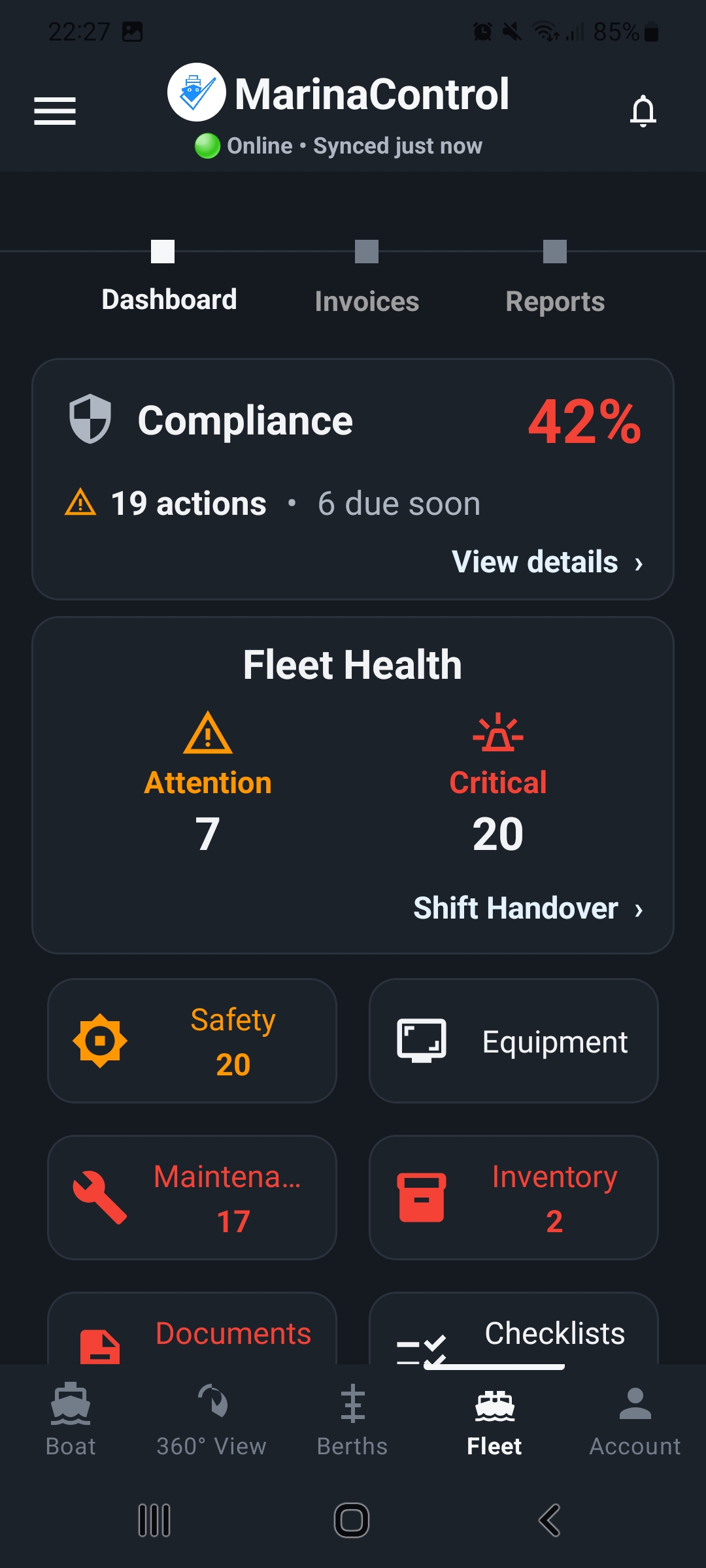
MarinaControl's Fleet Health view evaluates safety, documents, maintenance and inventory and surfaces the result as All Good, Attention or Critical.
Expired safety items and documents contribute to Critical status; approaching expiries contribute to Attention. Maintenance status and low inventory levels also feed the fleet-health picture. Critical and Attention indicators can focus the dashboard on records requiring review.
Request a MarinaControl demoFleet Health versus the 360° Client View
Fleet Health asks what needs attention across the wider operation. The 360° Marina Customer View brings customer, vessel, berth, financial information, alerts and recent activity into context around an individual customer relationship.
Fleet Health versus operational compliance
Fleet Health is primarily an attention mechanism. Operational Compliance asks where the combined state of key operating areas indicates exposure or reduced readiness.
CONNECTED MARINA OPERATIONS
Record the work once. Use it to understand the operation.
Connected information becomes more valuable when the records supporting day-to-day work also help managers identify priorities.
The wider principle
The goal is not more metrics. It is a clearer answer to a practical management question: where should we look first?
Operational note: Fleet-health indicators are management aids and do not replace a marina's own inspections, risk assessments, maintenance procedures, safety arrangements or professional judgement.